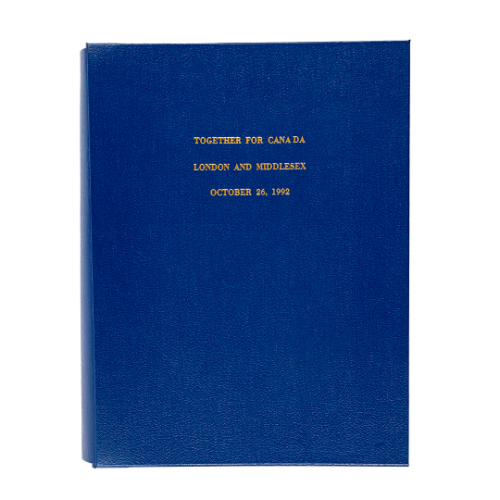
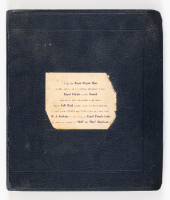
Book, Signature (Charlottetown Accord Supporters)
Date1992
Credit LineCollection of Museum London, 1993
Object number1993.015.001
Label TextThis blue book contains the signatures of Londoners who supported the Charlottetown Accord. Following the 1990 failure of the Meech Lake Accord, which attempted to bring Quebec into Canada's "constitutional family," the Mulroney government tried again in 1992 with the Charlottetown Accord. Canadians rejected the Accord in an October 26, 1992 referndum: 54.3 per cent of the vote was against. "It did win approval in New Brunswick; Newfoundland; Prince Edward Island; the Northwest Territories; and, by only 50.1 per cent, in Ontario. In Quebec, the vote was 56.7 per cent against." "The terms of the Accord would have given the provinces power over forestry, mining, cultural affairs and some other areas. The federal government would keep control over national groups such as the CBC and the National Film Board. Under the Accord, a province could opt out of a federal program. It could do this if it started a similar program of its own. Many trade barriers between the provinces would be removed. The federal power of disallowance would have also been scrapped. The Accord addressed the issue of Indigenous self-government. But it gave a waiting period of three years before it would be recognized in law. The Accord also had the “Canada Clause.” It set out the values that define the Canadian character. One of those values was that Quebec is a distinct society within Canada. Under the Accord, the Senate would become “Triple-E” — equal, elected and effective. The Senate’s powers would be reduced. Some matters would require a so-called double majority; that is, a majority of all senators and of francophone senators. The structure and appointment process of the Supreme Court would also be entrenched in the constitution. The number of seats in the House of Commons would go up. Quebec would always have at least one quarter of all seats in the House. The number of constitutional matters that need unanimous consent to be changed would go up."
From: https://thecanadianencyclopedia.ca/en/article/charlottetwon-accord-plain-language-summary#:~:text=would%20go%20up.-,Referendum,was%2056.7%20per%20cent%20against.&text=Your%20browser%20can't%20play%20this%20video.&text=An%20error%20occurred.,is%20disabled%20in%20your%20browser.
NameBook


After 1946
1940 - 1945