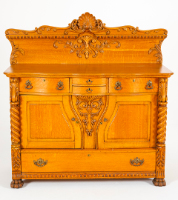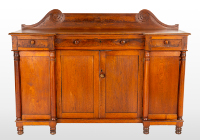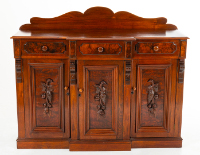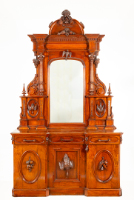
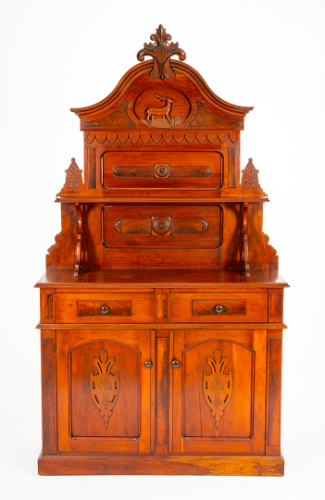
Upper Canada Style Carved Sideboard
Datec. 1875
Dimensions215.9 × 121.9 × 50.8 cm (85 × 48 × 20 in.)
Credit LineCollection of Museum London, 1993
Object number1993.012.001
Label TextWe’re looking at a Victorian dining room sideboard, made of cherry wood, and constructed around 1875. It combines elements of rococo revival and Gothic revival styles. The rococo elements can be seen in the curved pediment with its fleur-de-lys-like crest. As well, the paneled backboard features a carving of a stag. The Gothic revival elements include the shield-like details on the two cabinet doors. That shield motif repeats as dentellation along the backboard just below the pediment. The sideboard also features a shelf held up by carved supports.
This piece is fascinating. We know nothing about the maker or the owner. Our records tell us that it had been carved on the Harris family farm. The Harrises were a prominent London family whose home, Eldon House, is now a museum. John Harris, Treasurer of the London District from 1821, built Eldon House in 1834. He, his wife, Amelia, and their children became important figures in the social and business life of the community. We are fortunate in that five different Harris women kept diaries, Amelia Ryerse Harris included. Amelia refers to her farm near Long Point in Wodehouse Township in her diary. Her brother rented it, and it proved to be an important source of income to Amelia. But Amelia makes no mention of a cabinet having been constructed there.
With that avenue of research at a dead end, I inspected the sideboard a little closer and that proved to be an eye-opener. I had read “carved on the farm” and immediately envisioned a cabinetmaker working with a wide range of hand tools to make the various elements of the piece and then assemble it into the whole we have today. My imagination steered me wrong. A quick look at the sideboard’s construction revealed that it is made up of a combination of machine and hand made pieces.
A deeper dive into the history of furniture making in Ontario from the mid- to the late 19th century revealed that this method of construction was widespread, found in small local shops all the way up to large factories such as the London Furniture Manufacturing Company and Toronto’s Jaques and Hay. Historian Lily Koltun has noted that making a division between “hand” and “mass-produced” is impossible from the mid-19th century through to the 1870s. She noted that a factory piece may have had much hand labour in it, though not all performed by the same man. As well, a handmade piece may, as in the case of our sideboard, be an assemblage of machined parts. Kolutn characterizes the last half of the 19th century as “transitional.” It was the period during which furniture making began to change from handcraft to factory production.
It's no stretch to realize that it was quicker to make furniture that included factory-made components. This reduced the price for the consumer, who now could afford all the embellishment and ornamentation that marked a piece as fashionable in the Victorian era. And made of cherry, described as North America’s answer to mahogany, added to the cachet of the piece. Finally, by last third of 19th century, the phrase “machine made” had a desirable ring to it. It suggested progressive methods, exactness, and modern style. For these reasons, this sideboard would have been a mark of status and respectability for the discerning consumer who acquired it to be a centrepiece in their home.
NameSideboard