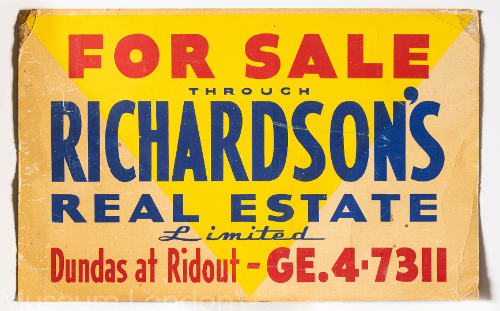
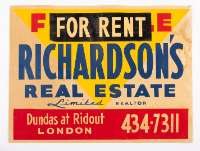
Richardson's Real Estate, "For Sale" Sign
Date1960
Dimensions35.3 × 55.7 cm (13 7/8 × 21 15/16 in.)
Credit LineGift of Earl Leiska, London, Ontario, 2026
Object number2026.003.001
Label TextIn August 1960, Earl (d. 2011) and Gloria Leiska (d. 2009) bought 154 Mark Street, in London’s new suburb, Huron Heights, located in the northeast portion of the city. This Richardsons’ Real Estate sign, with the “sold” sign, had been on their front yard. Prior to moving to Huron Heights, the family had lived on Carfrae Crescent. Like many other families who moved out to the suburbs, the Leiska’s were looking for more space for their growing family. Earl, senior, remained in the home until 2010.
Ronald Owen Bryden Richardson (1918-2021) and his brother, Melville “Leverne” (1912-1970), operated Richardson's Real Estate Ltd. at Dundas and Ridout. They owned the larger structure in which their office was located. This structure, constructed about 1853, was on the site of the former Western Hotel which went up in flames in August 1850. In the early 1860's, the Richardson's building was used as a barracks for British officers and was known as the Royal Exchange Barracks until the removal of troops from London in 1869. From 1870 until 1892, the O’Callaghan’s owned the building, remodelling it into an apartment building known as O'Callaghan Terrace. Later, the building was known as the Westview Apartments. The City of London bought the property in 1975 for $465,000 and demolished it in November 1975. Museum London is now located where it once stood.
Development of Huron Heights began around 1960 when the area was still part of London Township. This development was part of the suburban sprawl that impacted post-war Canada, London Township included. Indeed, London Township’s population “increased by more than 66 per cent between 1951 and 1956.” This growth accelerated with developments like Huron Heights. In part, this growth led to London’s successful bid to annex a large portion of London Township in 1961, which also encompassed what was known as Oxford Street’s “Golden Mile,” a stretch of road that included the GM and 3M plants.
NameSign, Advertising
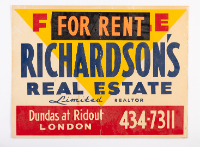
c. 1970
c. 1970