
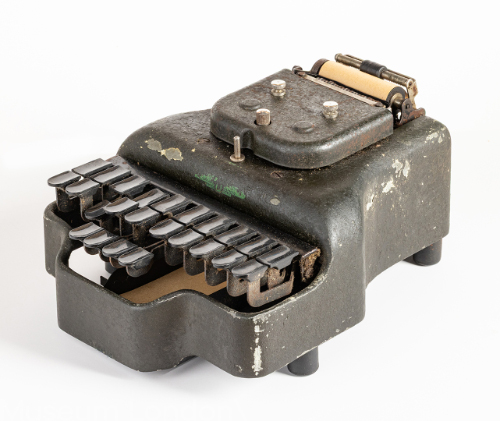
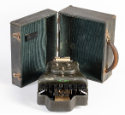
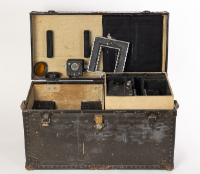
Master Model 4 Stenotype Recorder and Case
Datec 1927
DimensionsRecorder: 12 × 19.5 × 25.4 cm (4 3/4 × 7 11/16 × 10 in.)
Case: 15.2 × 28.2 × 25.4 cm (6 × 11 1/8 × 10 in.)
Case: 15.2 × 28.2 × 25.4 cm (6 × 11 1/8 × 10 in.)
Credit LineTransfer from the Huron County Museum and Historic Gaol, Goderich, Ontario, 2026
Object number2026.004.001
Label TextLaurence Edmund Talbot used this stenotype recorder in the early 1930s as a court stenographer at London’s historic courthouse, following his 1931 graduation from Westervelt Business College. Talbot then worked at London's Cities Service Oil, and after 10 years, entered the ministry. A pastor at seven churches in Ontario, Talbot spent the last 15 years of his career working in an administrative capacity.
As a student at Westervelt Business College,Talbot likely purchased the stenotype recorder in preparation for his studies, as was standard practice at the time. As for the recorder, itself, the Stenotype Company of Indianapolis, Indiana, first manufactured the Master Model 4 stenotype recorder. From the late 1920s into the 1940s, the LaSalle Extension University held the rights to produce it, for which reason the device is often referred to as a LaSalle stenotype recorder. The machine has 22 keys in 3 rows. With its chorded Ireland keyboard, the user pressed multiple keys at once to print syllables or entire words onto a narrow strip of paper.
The stenotype machine was an important technological evolution for stenographers working for the legal system and in business. For decades, workers transcribed information in longhand before adopting shorthand. With the adoption of stenotype recorders in the early 20th century, stenographers could transcribe far faster than before.
NameTypewriter (Stenograph)
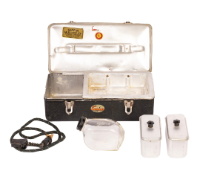

c. 1930
EASTMAN KODAK CO.


c. 1951

