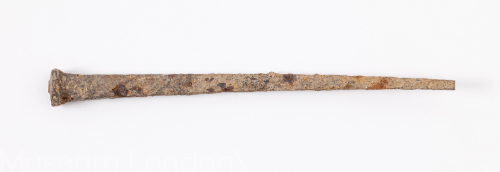
Thames Nail
Dimensions1.7 × 17.5 cm (11/16 × 6 7/8 in.)
Credit LineGift of Hilary Neary, London, Ontario, 2026
Object number2026.006.002
Label TextThis nail once formed part of the crib dam at the Meadowlily Mill site. Extant records do not reveal exactly when a mill was first constructed on Lot 8, Concession A, the site of the Meadow Lily Mill, but one was certainly operating in 1847. A May 31, 1849, advertisement listing the mill property for sale described it as “that desirable grist and saw mill, lately erected on the south branch of the River Thames . . .” The mill changed hands multiple times in the 1850s, but Charles Robertson purchased it in 1856. He called it the Meadow Lilly Mills.”
Robertson’s ownership of the property didn’t last long. Its operation soon passed to a tenant: Alexander Edward Parker. The 1861 census gives a more detailed picture of his family and the mill he was running. The Parkers lived in a one-storey log house, and three of their five children were attending school. The mill was water powered, employed two hands, had a capital investment of $10,000, and had ground 6,000 bushels of wheat the previous year to a value of $30,000.
In March 1870, William Plewes purchased the Meadowlily Mill. The 1871 census gives a detailed picture of both the Plewes family and of the milling operation:
● William (40 years) and Amelia (née Case, 28 years) had five children.
● They lived on 30 acres of land of which six were improved, three were pasture, 10 were marsh, and four were in gardens and orchards. The previous year, 20 bushels of potatoes had been harvested from a ¼ acre plot, and one ton of hay.
● They had three horses, one colt or filly, one milch cow, and three swine.
● The property included two dwelling houses, one warehouse/store/factory (in this case, a mill), one barn, two carriages/sleighs, three carts/waggons/sleds, and one pleasure or common boat.
● A flour & gristmill was under the operation of Plewes and his partner, James Josiah Crow, with $6,000 of fixed and $10,000 floating capital.
● The mill had operated for 12 months the previous year (indicating the reliability of its water supply), and employed five men, at an aggregate wage of $1,200. The mill operated on waterpower equal to 30 horsepower.
● In 1870, the mill had processed 100,000 bushels of wheat (valued at $130,000) producing 22,222 barrels of flour valued at $133,332, and 444 barrels (or bushels – the census is imprecise here) of bran and other offal, valued at $4,440.
Over the years, Plewes built additions to the structure and, in 1883, introduced the roller process, which maximized the amount of flour that the mill could extract from the grain.
In February 1886, the frame mill suffered a fire. Plewes estimated his loss at $25,000 (only $8,000 was covered by insurance), and quickly engaged the London builder, William Hayman, to construct a three-storey, brick mill, on a stone foundation, costing $17,000. By 1889, the mill had a capacity of 150 barrels a day and employed twelve men. The leading brands of flour were “Cream,” “Straight,” “Tip-Top,” “Plewes Extra,” and “Meadow Lillie.” In 1891, the mill was again destroyed by fire and immediately rebuilt. William Plewes died in 1895, having owned the Meadow Lily Mills for a quarter of a century. The mill was taken over by his son Heber Plewes. It changed hands in 1901. By 1908, there is no evidence of milling taking place at the site.
NameNail