Image Not Available
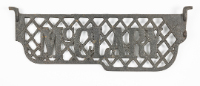
for McClary Hot Air Register
McClary Hot Air Register
Credit LineGift of Mr. Jim Hunter, 1976
Object number1976.068.004
Label TextThis McClary hot air register came out of 713 York Street. The home was located on the south side of York Street and was just east of Adelaide, in a solidly working class neighbourhood. It backed directly onto the Grand Trunk Railway. According to the 1907 fire insurance plans, 713 York Street was a one and a half storey home constructed of brick veneer. It featured four window openings on its west side and three on its east side. The home had been built some time after 1883. It stood on land that had once been the location of the Imperial Oil Company, which left London in 1883 after a lightening strike damaged the refinery.
Charting changes over time to 713 York and the site on which the home stood is interesting. In 1907, the home's west side looked out onto a woodyard. Behind the home was a frame stable and woodcutting shed, which included a steam boiler as a power source. At the very back of the property, on the west side, fronting the Grand Trunk Railway, was a coalshed. According to the 1915 fire insurance plan, the home had expanded to include a small frame structure attached to the back, possibly a kitchen. Along the entire length of the back of the property, fronting the Grand Trunk Railway, was a frame structure, likely a storage building. And by 1922, the wood yard had become a coal yard, the stable and wood cutting shed had become a coal shed, and the storage building facing onto the Grand Trunk Railway was gone, replaced by two concrete silos that took up a much smaller footprint.
William Henry Proctor (188601969), his wife Alice May Rowe Proctor (1889-1983), and his father Wiliam Proctor (1856-1937), lived for decades in the home. William Henry was a conductor with the Grand Trunk Railway (later the CNR). The family occupied the house from at least 1914 until 1969. It was demolished not long after.
NameGrate, Register

JAS STEWART MFG. CO. LTD.
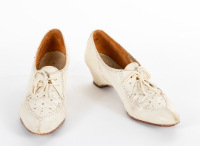
c. 1950s
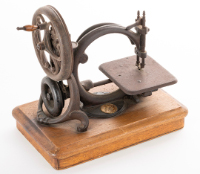
WILLCOX & GIBBS