
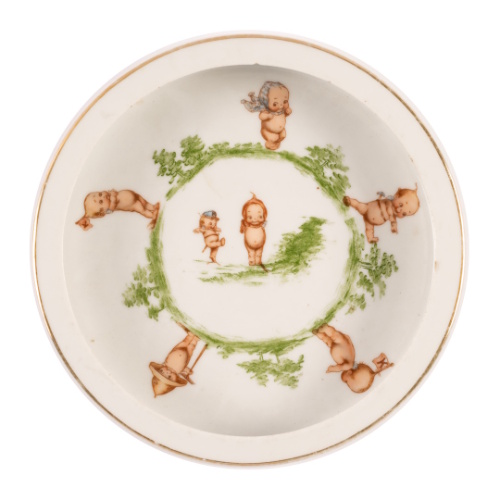
Bowl with Painted Kewpie Dolls
Date1910s-1920s
Dimensions19.8 cm
Credit LineGift of Jessie Robins, London, Ontario, 1980
Object number1980.043.071
Label TextThis bowl is decorated with Kewpie Dolls. American artist Rose O'Neill introduced the Kewpie character, with its fat little belly, tuft of hair, and whimsical expression, in 1907 in cartoons that children could cut out of publications. They made their debut as dolls in 1913 and sold millions within the first year. O'Neill is fascinating. The Library of Congress writes: "Rose Cecil O’Neill was an iconoclast in every sense of the word. A self-taught bohemian artist, who ascended through a male-dominated field to become a top illustrator and the first to build a merchandising empire from her work, with her invention of the Kewpie doll.
As a young woman coming of age in the late 19th century, Rose redefined what a female artist of the time could achieve both creatively and commercially.
Born in Pennsylvania in 1874, O’Neill relocated with her family by covered wagon to rural Nebraska. She began drawing in childhood and, at age 13, won a newspaper drawing contest in her adopted hometown of Omaha. At just 18, and with no formal art education, had her drawings published in newspapers and magazines throughout the Midwest. Within the year, she moved to New York with hopes of launching a career as an artist.
Settled in Manhattan, O’Neill quickly made a name for herself as a commercial illustrator, publishing in national magazines such as Life, Ladies’ Home Journal and Harper’s Monthly. At 23, she became the first woman artist on staff at the leading humor magazine Puck. She was now earning top dollar for her work, making her one of the highest paid illustrators in New York.
At the same time, O’Neill remained dedicated to her own creativity fulfilling art. As a sculptor and a painter, she exhibited her work in New York and Paris. As a novelist and poet, she published eight novels and several children’s books
O’Neill also was an activist for women’s issues. She marched as a suffragist and illustrated posters, postcards and political cartoons for the cause. She championed dress reform, choosing to be brazenly corset-less underneath loose caftans.
In 1907, O’Neill began developing short illustrated stories featuring cherubic characters, who “did good deeds in a humorous way.” The comic strip “The Kewpies” premiered in Ladies’ Home Journal in 1909 and was an instant hit. The strip’s spectacular popularity inspired her to envision the Kewpie as a doll. Kewpie dolls hit the shelves in 1913 and immediately became a phenomenon—it took factories in six different countries to fill orders. The Kewpie became the first novelty toy distributed worldwide and earned O’Neill a fortune.
Wealthy beyond her dreams, O’Neill retreated to Castle Carabas, a lavish villa in rural Connecticut, where she entertained artists and other exotic visitors. Over time, O’Neill’s generosity and extravagant living depleted her funds. In 1941, she moved into a family home in Missouri to work on her memoirs and died in 1944, penniless.
For over a century, the Kewpie remained an icon of American popular culture. The vitality and versatility packed into O’Neill’s lifetime ensured that her contribution to American culture would continue to stand the test of time."
https://blogs.loc.gov/headlinesandheroes/2020/03/rose-oneill-artist-activist-and-queen-of-kewpies/
NameDish, Eating


c. 1900


