
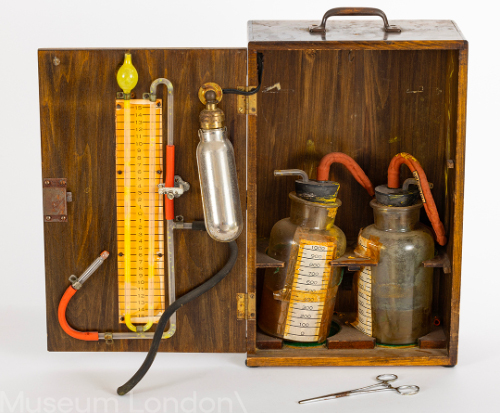
Pneumothorax Machine
Datec. 1930s
DimensionsOverall: 49.5 x 16 x 26.5 cm
Credit LineGift of the London Health Sciences Centre, London, Ontario, 2004.
Object number2004.038.592
Label TextBefore the discovery of effective antibiotics, pneumothorax machines like this were vital in the treatment of patients with pulmonary tuberculosis. Physicians realized that if a diseased, cavity-ridden lung could "rest," the body's immune system could heal the infection more effectively. The machine was used to induce an artificial pneumothorax (a collapsed lung). It consisted of a hollow needle, a hydraulic or hand pump, and a pressure gauge. A physician would insert the needle between the patient's ribs into the pleural space (the cavity surrounding the lung) and pump in sterile nitrogen or air. The gas created pressure against the lung, causing it to partially or completely deflate and collapse, which mechanically closed tuberculous cavities and gave the lung time to heal. The technique was developed in the late 19th century by Italian physician Carlo Forlanini. While it was a groundbreaking therapy in its time, artificial pneumothorax was entirely rendered obsolete by the invention and widespread use of antibiotics (like streptomycin) in the 1940s and 1950s.
NameApparatus, Pneumothorax

c. 1885