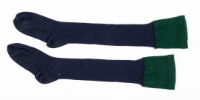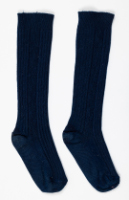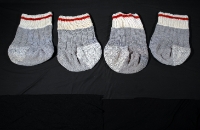
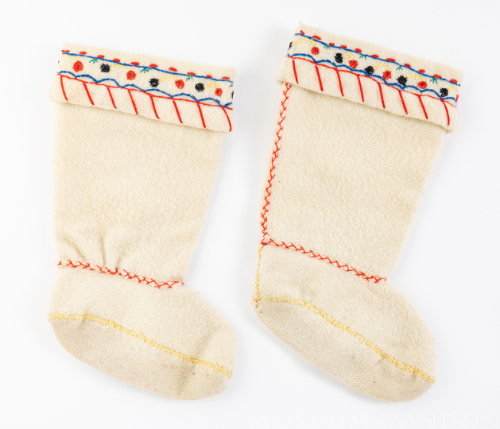
Pair of Duffle Socks
Dimensions43.2 × 20.3 cm (17 × 8 in.)
Credit LineGift of Beverley Corlett, London, Ontario, 2025
Object number2025.003.002
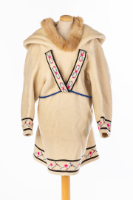
Label TextDuring the summer of 1962, Beverley’s then husband, Glenwood Robert “Bob” Corlett, served as a dental assistant aboard the CGS C. D. Howe. While in Pond Inlet, Labrador, Bob, in Beverley’s words, “got” the parka for her because she was pregnant with their first child. Living in Toronto at the time, Beverley wore the parka, placing her daughter in the pouch. She brought the garment with her to London when the family relocated to the city in 1972. The parka, made of duffle cloth, was intended for settlement living versus living on the land, for which purpose parkas were made of skins.
The 2013 Qikiqtani Truth Commission Community Histories 1950-1975 Pond Inlet report* notes that at the time of publication the community was a hamlet of 1,549 people, 92% of them Inuit, located on the east side of Eclipse Sound, about 700 kilometres north of the Arctic Circle on Baffin Island. Its local name in the Inuit language is Mittimatalik, and the people of the region are known as Tununirmiut, which is thought to mean “people of the shaded place” or Mittimatalingmiut, meaning “people of Mittimatalik.” The site has been occupied for four thousand years, through periods known to archaeologists as pre-Dorset, Dorset, Thule, and modern Inuit.
The report describes the history of contact with Qallunaat (white) whalers and traders, stating that from the 1820s, Qallunaat whalers and then traders began to frequent the area, and Inuit began to modify their seasonal round to meet them. In 1903, Scottish entrepreneurs set up the first permanent trading stations, providing year-round access to trade goods. For its part, the Hudson’s Bay Company settled at Pond Inlet in 1921, and the RCMP arrived in 1923, followed by Roman Catholic and Anglican missions in 1929. Through the 1920s to 1945, the Inuit residents of Pond Inlet began to adopt a wider range of imported goods: “Despite a general continuity in the Tununirmiut way of life, sixty years of steady contact with incomers did introduce new elements of material culture. Imported manufactured goods, textiles, and foods steadily came into general use…Rifles and hand-operated sewing machines performed many of the tasks most essential to survival, and there was a growing demand even for luxuries unconnected with earning a living, such as radios, phonographs, and clocks.”
The years 1945 to 1962, the report continues, was a time of disruption. From the 1950s, the government began to assert its sovereignty in the Arctic, one of the reasons for the presence of the CGS C. D. Howe. In the early 1960s, the Canadian government began to implement its new program of northern economic development. The government also opened a residential school in 1961. As authorities compelled children to attend school in Pond Inlet, more families resorted to living in the community on a full-time basis so that they could remain close to their children. The alternative for the children was hostels. Still another factor that prompted permanent settlement in the hamlet was a shift to waged labour. Pond Inlet grew from having 65 permanent Tununirmiut residents in 1962 to 336 in 1968.
Finally, the period 1945 to 1962 was also marked by a tuberculosis epidemic, something with which the C. D. Howe was intimately involved. In the early 1960s, in addition to carrying supplies, the vessel provided dental care and medical assistance to the communities along the Labrador coast. Dental care consisted largely of extractions. For its part, the medical care focused on screening residents for tuberculosis. Medical personnel removed afflicted individuals from their homes to sanatoria in the south, particularly the Hamilton Mountain Sanatorium. Those with the illness were separated from their families and friends for months or even years. And some never returned home.
The parka is intimately connected with this complex history. It is both evidence of continuity of the Inuit culture as well as the impact of colonialism on that culture. The parka follows a traditional pattern but uses duffle cloth versus skins in its construction. Historian Myra Rutherdale, in a 2013 book chapter entitled “Packing and Unpacking: Northern Women Negotiate Fashion in Colonial Encounters during the Twentieth Century,” quotes Carolyn Soper, a nurse in Lake Harbour in the early 1930s, who said that:
It fell to Neve’s lot to make our Arctic clothing. Caribou skins were used for winter; duffle cloth for summer…No patterns were used. She studiously looked us over for size and then went to work. In what seemed to me a remarkably short time, she returned with our duffle parkas … (p.121)
As the Truth Commission report noted, Inuit adopted trade goods, among them duffle cloth.
Before Inuit moved into permanent settlements, women’s sewing of different skins as well as duffle, was as important to the community’s survival as Inuit men’s hunting. Men could not hunt if they did not have the appropriate garments and footwear. The rest of the family required garments, too. Even after Inuit moved into permanent settlements women’s sewing continued to be important for its economic importance and cultural significance. However, the conditions under which the sewing was done became more difficult. Caring for a southern style home and adopting southern standards entailed more and different household responsibilities than living in camp. And yet it was still a central activity for women because their sewing contributed to the family’s household budget. Not only did the garments they make not need to be purchased but women sold their products to others. Although women’s sewing hadn’t been commodified to the same degree as carving under government policy, it did occur to some degree and women earned income through sewing this way, too.
NameSock