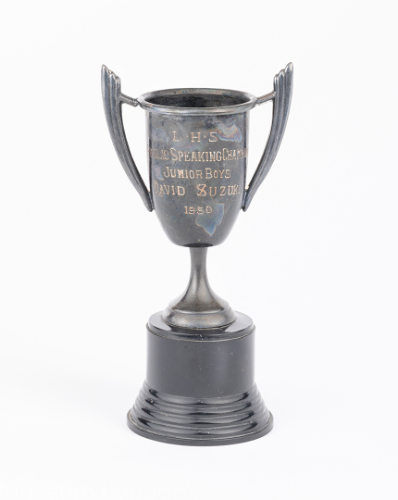
David Suzuki’s L.H.S. Public Speaking Champion (Junior Boys) Trophy
Date1950
Dimensions17 × 8.5 cm (17 × 8.5 cm)
Credit LineGift of Dr. David Suzuki, Vancouver, British Columbia, 2026
Object number2026.008.001
Label TextDavid Suzuki (b. 1936) spent most of his high school career in London, Ontario. He went on to become an internationally renowned environmentalist, geneticist, and broadcaster. His family’s arrival in London, around 1950, was not easy. They were among those Japanese Canadians forcibly sent to internment camps during the Second World War and later expelled from British Colombia.
In the early 1900s, Suzuki’s grandparents arrived in British Colombia. His father, Carr Kaoru Suzuki (b.1909) and mother, Setsu Nakamura, (b.1911) were both born in Vancouver. Together his parents started a laundry and dry-cleaning shop. Suzuki and his twin sister, Marcia, were born on March 24, 1936.
During World War II, in 1942, his mother with three young children were sent to Slocan City internment camps. Upon arrival Suzuki recalls, in his memoir Lessons from a Lifetime: 90 Years of Inspiration and Activism (2026) that “we were surrounded by other Japanese Canadian housed in rotting buildings with glassless windows.” His father worked on a road camp separated from his family.
After the war, Japanese Canadians were expelled from British Colombia and Suzuki’s family were made to board a train to Toronto. His mother found work on a peach farm in Essex County. A year later the family moved to Leamington, where his father found work at a dry-cleaning plant. Suzuki entered Leamington District High School for grade 9. He loved this school. He earned his first public speaking award in the form of this trophy. He spoke about the protection of the earth.
Public speaking and advocacy would remain significant to Suzuki during his time at London Central Collegiate (known today as London Central Secondary School). Suzuki came to London for grade 10. The family lived at 10 Fernley Avenue (near Oxford and Wharncliffe Road). Suzuki spent his summers working for Suzuki Brothers Construction Ltd. Writing in his memoir about his time at London Central Collegiate and public speaking:
“By the time I arrived for grade 10 at London Central Collegiate, social circles were well established and I was a stranger … In my last year of high school one of my fellow nerds suggested I run for school president. I said no. When I told my father, he was disappointed and asked why … So I went back to my friend and said I would give it a try.
My public speaking in oratorial contests served me well during the campaign at Central, and I appealed to the Outies. To my amazement, I won with more votes that all other candidates combined. It was another powerful lesson: There are a lot more Outies than Innies, and together that means power.”
During high school Suzuki met his first wife, Setsuko Joane Sunahara, with whom he had his first three children. She attended H.B. Beal Technical and High School.
In 1961 Suzuki graduated with a PhD in zoology from the University of Chicago. He later joined the University of British Columbia. From 1979 to 2023 Suzuki hosted CBC TV’s The Nature of Things. In 1990, he established the David Suzuki Foundation.
Today, Suzuki is world leader in sustainable ecology and has received numerous awards, including a UNESCO prize for science and a United Nations Environment Program medal. Daivd Suzuki is a Companion of the Order of Canada.
NameTrophy