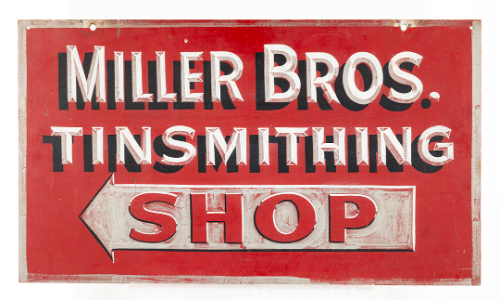
"Miller Bros. Tinsmithing Shop"
Datec. 1940s
DimensionsOverall: 72 x 41 cm
Credit LineGift of Alfred Miller, London, Ontario, 2005.
Object number2005.012.001
Label TextLocated at 663 Dundas Street, the Miller Bros. Tinsmithing Shop opened in 1918. Operated by three generations of Millers. The business had been the oldest operating business in East London when it closed. George and Wifred Miller bought an existing tin shop on the site in 1918 from a Mr. Parks who had been in business himself on the same location at least as early as 1885, making it one of the oldest continuously occupied shops in London. Most of the shop's tools were sold to another tin shop when the business closed.
George’s son Wesley joined him in 1929 and for decades they worked together, making ductwork, repairing eavestroughs, and installing furnaces. When George died in 1956, Wesley took over the business. After Wesley hurt his hand in 1982 his son Alfred joined the shop. Their work often became more specialized. They made everything from reproduction architectural pieces to custom cookie cutters. When Wesley passed away in 1998, Alfred became the third generation to operate Miller Brothers, serving a loyal customer base until his retirement in 2004.
Tinsmiths have practiced their trade in Canada since the 18th century. Early tinsmiths used tinplate, solder, and a few simple tools to produce their wares. They learned their trade by serving an apprenticeship of 4 to 6 years under a master tinsmith, and began by learning how to create simple objects such as cookie cutters and pill boxes. Once the apprenticeship was completed many young tinsmiths took to the road as peddlers or “tinkers,” visiting farms and small communities prior to opening their own tinsmith shop.
By the mid-1800s, most towns in Canada had a resident tinsmith who made a variety of tin goods for both farm and household use. Popular items that could be found in such a shop included scoops, lanterns, buckets, pots and pans. Tinsmiths also produced building components such as stove-pipes and eavestroughing.
Products made from tin became increasingly popular due to their versatility and relatively inexpensive cost, and were often used to replace objects made from pewter, wood and earthenware. The demand for tinware brought about the development of the first handpowered cutting and forming machines which improved efficiency and sped up production of the finished products.
London’s central Ontario location made it an ideal regional centre for a diverse group of businesses and services, including a number of tin shops. By the turn of the century tinsmiths were not only supplying household and agricultural products, but were also installing furnaces and ductwork for central heating in homes. Many shops, such as McClary Manufacturing Ltd. of London, expanded rapidly to meet consumer demand for these new products.
NameSign, Trade