
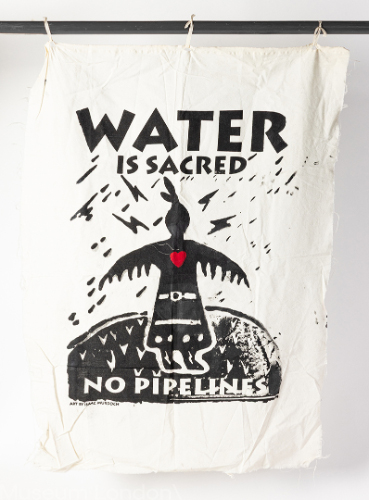
"Water is Sacred / No Pipelines"
Date2016
Dimensions91.4 × 66 cm (36 × 26 in.)
Credit LineGift of Leslee White-Eye, Muncey, Ontario, 2025
Object number2025.011.001
Label TextIn November 2016, members of the Chippewas of the Thames First Nation (COTTFN) carried signs like this on the grounds of the Supreme court of Canada. The COTTFN was fighting to protect the Thames River Watershed in a case before the Supreme Court of Canada. They had asked the Court to overturn the 2013 National Energy Board (NEB) decision to allow Enbridge to change the operation of Line 9, an oil pipeline running through their territory, first installed in 1976. A spill would cause environmental, cultural, and spiritual devastation. Their case argued that the Crown had failed in its duty to consult.
In November 2012, Enbridge “filed an application under section 58 of the NEB Act seeking approval to modify a section of its existing Line 9 pipeline allowing it to move a larger volume of heavy crude oil passing directly through the territory of the Chippewas First Nation… [A]n application under s. 58 does not require further ministerial consideration or approval, thus, the Board is the final decision maker.” The NEB initiated hearings to which the COTTFN contributed. In September 2013, the Nation also wrote to the Prime Minister, the Minister of Aboriginal Affairs and Northern Development Canada, and the Minister of Natural Resources. “The letter outlined the First Nations’ assertions of Aboriginal, treaty and title rights within the impacted area and specifically raised the issue of the Crown’s failure to consult and accommodate.” In January 2014, after the NEB hearings, but before the ruling, the Minister of Natural Resources replied to the letter, saying that the Crown relied on the NEB’s process to fulfil the duty to consult. The COTTFN “applied for judicial review of the Board’s decisions on the grounds of insufficient consultation. Chippewas of the Thames argued that the Crown’s constitutional obligations under section 35 could not be satisfied by a regulatory process in which the Crown did not participate.” In its 2016 decision, the Supreme Court backed the ministerial position and upheld the NEB ruling to allow Enbridge to reverse the flow of oil.
NameBanner



Charlton Advt. Company


